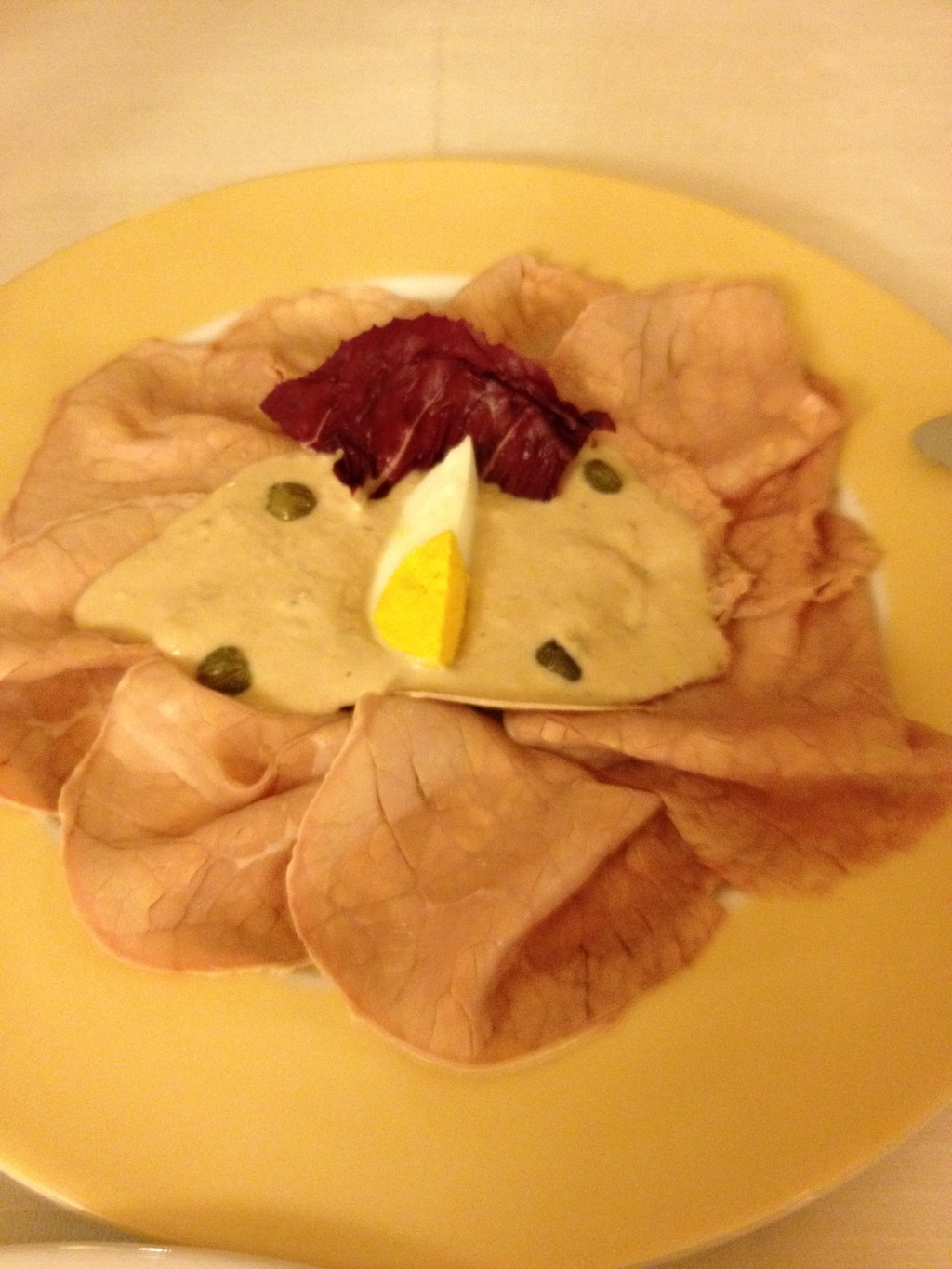
This is a very Piedmontese dish and one that you will find in the best restaurants in Torino. Tuna figures in a great many Italian dishes and nowhere more inventively than in the Piedmont area.
2 1/2 lbs Lean Veal Roast – preferably top round
1 Large Onion – cut into chunks
1 Bay Leaf
1/2 Cup Dry White Wine
2 Carrots – peeled and cut into chunks
2 Celery Stalks – cut into chunks
4 Parsley Sprigs
2 Garlic Cloves – whole, peeled
1st STEP POACHING VEAL: Put the veal in a heavy bottomed pot, one with high sides – I use a LeCreuset #26. Add carrots, celery, onion, parsley, garlic clove, bay leaf, sprinkled with a little salt and pepper, dry white wine and enough water to cover all. Remove meat, set aside, cover pan and bring to a boil. Return meat to the pot, return to a boil then cover, lower heat and simmer gently for about 2 hours. Check occasionally and add more water or some wine if necessary. After 2 hours, remove the pot from the heat, set aside and allow the meat to cool in the stock.
For the Tuna Sauce
1 Can (7 oz.) of Italian Imported Tuna – packed in oil
1 cup Extra Virgin Olive Oil
1 1/2 cup mayonnaise – preferably homemade or Hellmann’s Real Mayonnaise
3 TBS Capers – soaked and rinsed
5 Flat Anchovy Fillets
3 Tbs. Lemon Juice – freshly squeezed
Drain the tuna and put into a food processor with the anchovies, olive oil, lemon juice and capers. Process until it becomes a creamy sauce. Fold sauce gently into the mayonnaise, cover and refrigerate.
Putting it together
Thin Slices of Lemon – preferably sliced using a mandolin
Chopped Fresh Parsley – for garnish
Whole Capers
Anchovy Filets
When the meat has cooled, transfer it to a cutting board and carefully cut in very thin, uniform slices. (Save the broth and use when making risotto or soup.) On a serving platter, spread a little of the tuna sauce on the bottom. Arrange the tuna slices, overlapping slightly over the sauce and then cover with some sauce. Repeat layers ending with the sauce, cover with plastic wrap and refrigerate for at least 24 hours so that all the flavors can marry.
Before serving, bring to room temperature and garnish with lemon slices and some additional anchovy fillets, capers scattered and some fresh parsley.
NOTE: this dish can be served as an appetizer or a main course accompanied by some sauteed green vegetables. Also, because veal can be very expensive, I’ve read that this dish can be made using chicken breasts.
A mandoline (which can also be spelled mandolin and confuse you with the musical instrument) is a vegetable slicer (a flat body gadget with adjustable slicing blades) that always looks like it will take your finger off and can in a jiffy if you don’t use the guard.
PS. I was raised in a very traditional Italian house where Sundays were spent visiting grandparents and relatives, except on those Sundays when my Mother would be in New Jersey helping my Grandmother in the Giovanna Farm Pensione and I had the pleasure of spending the day with my Dad going to Central Park or maybe a ball game or some other fun thing.
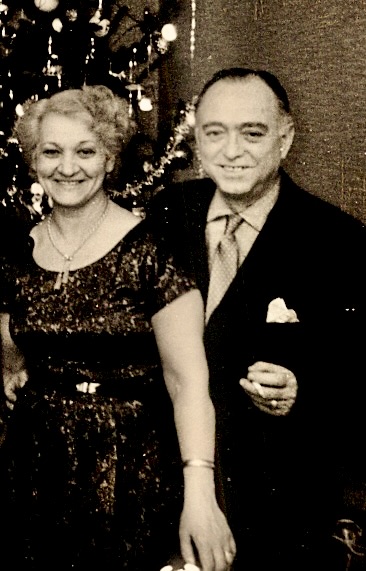
However, many family Sundays found us visiting my Aunt Tillie and Uncle Mando. They lived in what they lovingly referred to as a bungalow; I called it a doll-house. It was on a quaint tree-lined street of similar houses in Elmhurst just a short subway ride from NYC but to me it was country. My Aunt loved flowers, she had a green thumb, and her backyard was always in bloom and her kitchen perfumed with the aroma of something freshly baked.
My Uncle Mando was an excellent cook so dinners at their house were always a gastronomic experience and this was one of the dishes he made. I had it on a recent trip to Torino and it brought back such wonderful memories of sitting at their big table with my family and our cousins. Sometimes my cousin Ric would strum his guitar and my Uncle in his falsetto voice along with my cousin would sing a few Italian melodies. Sometimes I resented the fact that I couldn’t join my friends in going to a Sunday matinee but now I cherish the memories.
A LITTLE ABOUT PIEMONTE
I add this here because I share ancestry between Piedmontese and Toscano, professing strongly to being Sienese. However, I’m fortified with the knowledge that I can go far back in tracing my family roots back to this area and most especially to a little hamlet called Castlenuovo Calcea which I will talk about at another time. My Mother , Aunt, Uncle and Grandparents were born in this area and my Uncle Mando is also from this area, born in Cuneo. As well as a slew of Aunts who were the Sisters of my Grandparents and an Uncle, my Grandmother’s brother. They all followed one by one several years after my Grandparents. Several of the sisters who I would refer to as Aunts moved to Hartford, Connecticut, because their husbands could work in the brick factory there, and raised families.
The Alpine region of Piedmont is enveloped by the countries of France and Switzerland, which both play a hand in the culinary traditions of Piedmont. It shares its Italian borders with Lombardy, Liguria, Emilia-Romagna and Valle d’Aosta. Piedmont houses eight provinces – Vercelli, Verbano-Cussio-Ossola, Novara, Biella, Cuneo, Asti, Alessandria, and Torino, in which the regional capital city of Torino sits.
Torino is a city of interesting contrasts between old world and new. The name of Torino is widely recognized as home to the famous Shroud of Torino, housed in the Cattedrale di San Giovanni Battista (“Cathedral of Saint John the Baptist”), but it is also the center of operations for automobile manufacturers such as Lancia, Fabbrica, Ghia, Alfa Romeo and Fiat. Torino’s appeal is heightened even more by its influence on the world of fashion with Zegna, Fila and Superga , to name few and also there is the city’s excellence in crafting artisan chocolates, no doubt influenced heavily by Switzerland and fine pastries thanks in part to France.
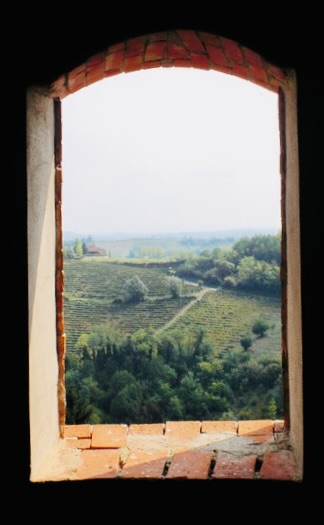
The valleys and pasturelands, protected in large part by the Alps, offer the ideal locations for growing grains like wheat, corn and most importantly rice. The terraced hills lend themselves well to grape and subsequently wine production. Garlic grows effortlessly in the region, (fortunate for me as I am passionate about garlic) and is an often-used flavoring in everything from soups to meat dishes to pasta and on and on!In Italy’s Ottimo’s Gelateria you will find garlic ice cream. Freshwater fish and eels are popular in Piedmontese cooking. Pork and pork products, as with most of Italy, are treasured at the table, as is good beef for the reason that cattle thrive in Piedmont, while the dairy industry is strong, injecting a love of cheeses, cream, milk and butter into its dishes. White truffles grow wild there, (much to my husband’s horror, we were having dinner, quite a while ago, at a restaurant where the evening’s specialty was pasta with white truffles. I did not know that they charged by the ounce for the shaved truffes, so I let quite a few slices go by until I was content. I don’t know what he paid for that meal but it sure was delicious.) and their distinctive flavor adds an earthiness to many recipes. Make no mistake, however, though locals love food, they greatly prefer quality to quantity, not difficult achieve in a region so overwhelmed with fresh produce, meats, cheeses pastries, chocolates and wines. And what more could one desire!
BUON MANGIATA!

 Ancora
Leave a comment