THE STYLE OF NECESSITY AND RESOURCEFULLNESS
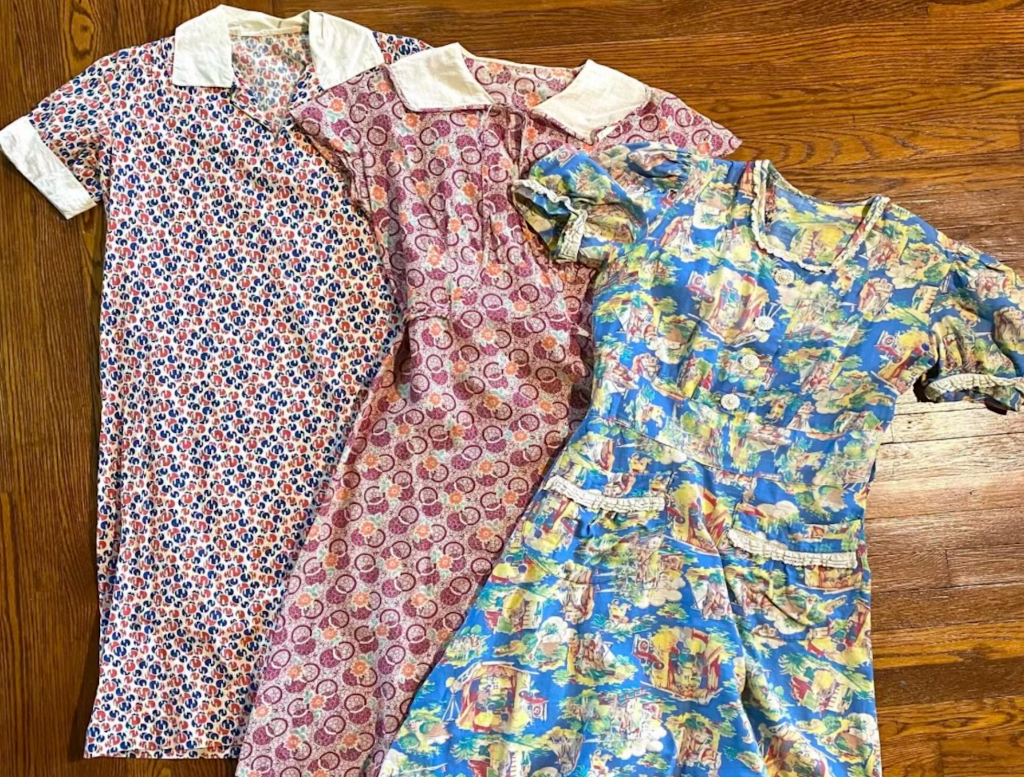
In rural United States far back in the 19th and 20th centuries, flour sack dresses and feed sack dresses were, out of urgency, a very common form of clothing. The dresses were homemade, fashioned, and sewn together by women utilizing the flour and feed sacks in which food commodities such as flour, wheat, sugar and other grains were transported and sold in. These garments, sewn out of necessity and usually by women were the quintessential part of life during the war and depression years and in many areas well into years thereafter.
Feed sack dresses, flour sack dresses, or feedsack dresses were a common article of clothing in many communities in the United States from the late 19th century through sometime into the 20th century. These dresses were made at home, usually by mothers and grandmothers, using the material from the cotton sacks in which flour, sugar, animal feed, seeds, and other commodities were packaged, shipped, and sold. They became a fitful part of life in some areas from the 1920s through the Great Depression, World War II, and post-World War II years. The mantra was “cloth is scarce, handle with care”.
Around October of 1924 Asa T. Bales, a millworker from Missouri, filed a patent for “a sack, the cloth of which is adapted to be used for dress goods after the product has been removed or consumed.” Bales assigned the patent to the George P. Plant Milling Company of St. Louis, Missouri, which by 1925 were manufacturing Gingham Girl sacks, which were sacks with color and design.
In 1925 the Textile Bag Manufacturer was created to increase industry sales. Working with the a few organizations it encouraged and introduced home sewing projects using feed sacks. In 1933 the US Department of Agriculture advertised the bags in a booklet as having “a high salvage value”, thus promoting their usefulness and practicality.
During World War II, dressmaking-quality fabrics became in short supply as textile manufacturers produced mainly for war efforts, and cotton yard goods were rationed. However, feed sacks were considered part of the “industrial” category of uses, so feed sacks were still available. Recycling of them was encouraged by the US government. According to the Textile Research Center’s Willem Vogelsang, “A bag that contained 5 lb. of sugar, for example, provided 1 foot of cloth, while a 100 lb. bag provided slightly more than 1 yard of cloth so that four purchased sacks provided enough for one adult woman’s dress. At the industry’s highest point, 1,300,000,000 yards of cotton fabric were used in commodity bags, in 1946.
(And that was probably the year I had a feedsack dress but more on that later).
After World War II, use of cloth sacks for packaging declined and was replaced with less expensive paper which, of course, was not useful for clothing and, therefore, most feed sack production ended in the early 1960s.
Research tells us that as early as 1890, however, some sacks were recycled on farms to be used as toweling, rags, or other functional uses on the farms. A paragraph in a short story reveals that possibly babies were wrapped in sacks.
By the beginning of the 20th century, flour sacks were produced in a variety of fabrics of tighter weave such as percale, a softer fabric, and sheeting and often printed in various colors and designs, and recycled, likewise specifically for clothing. Not only farm women but other women out of necessity recycled the sacks into clothing, and by 1925 the George P. Plant Milling Company of St. Louis produced Gingham Girl flour packaged in dress-quality yarn-dyed fabric, mostly red and white. By the end of the decade many other companies were producing decorative sacks and schools taught classes (and neighbor taught neighbor) on the use of flour sacks for clothing. A monthly newsletter called “Out of the Bag” was introduced. During the era of the “Great Depression” the popularity of the sacks increased, as they were seen as a source of free garment-making material for less fortunate families.
Women would get together to trade the sacks to allow for versatility and brand decisions were often being made by women rather than men which disgruntled feed store owners who complained about purchase decisions moving from the farmer to the farmwife as being unnatural. They were choosing product in bags that matched in order to have enough material to finish an article. Finding bags that matched was important as many patterns required more than a single sack. Sacks were saved and sack trading became a popular necessity so as to obtain enough material in the same print and/or same pattern to complete a dress.
According to Margaret Powell, speaking at the Textile Society of America’s 2012 symposium:
“In 1927, three yards of dress print cotton percale (the typical amount of fabric needed for an average size adult dress) could cost sixty cents when purchased from the Sears and Roebuck catalog. Three yards of gingham dress goods could cost forty cents. In comparison, three yards of dress quality gingham used in Gingham Girl Flour sacks from the George P. Plant Milling Company could be salvaged after the use of two or three one hundred pound bags of flour.”
During World War II it was estimated that 3 million women and children in the United States were wearing feed sack clothing at any given point in time. One participant in an oral history project stated that “everything on the clothesline was from feed sacks.” The US Department of Agriculture reported in 1951 that 75% of mothers living in urban areas and 97% of those living in rural areas had heard of making garments from feed sacks.
Undoubtedly there was an element of stigma or humiliation felt by those dressed in flour sack clothing, as it was seen as a mark of hardship or difficulty. I would imagine that it also caused some embarrassment to the male head of the household as it implied that they could not support their family’s needs. It is recognized in some pictures of that era that efforts were made to hide the fact the clothing was made from feed sacks, such as soaking off logos, dying the fabric, bleaching, or adding a little trim when possible. Women were resourceful!
E ora lo sai!
(And now you know.)
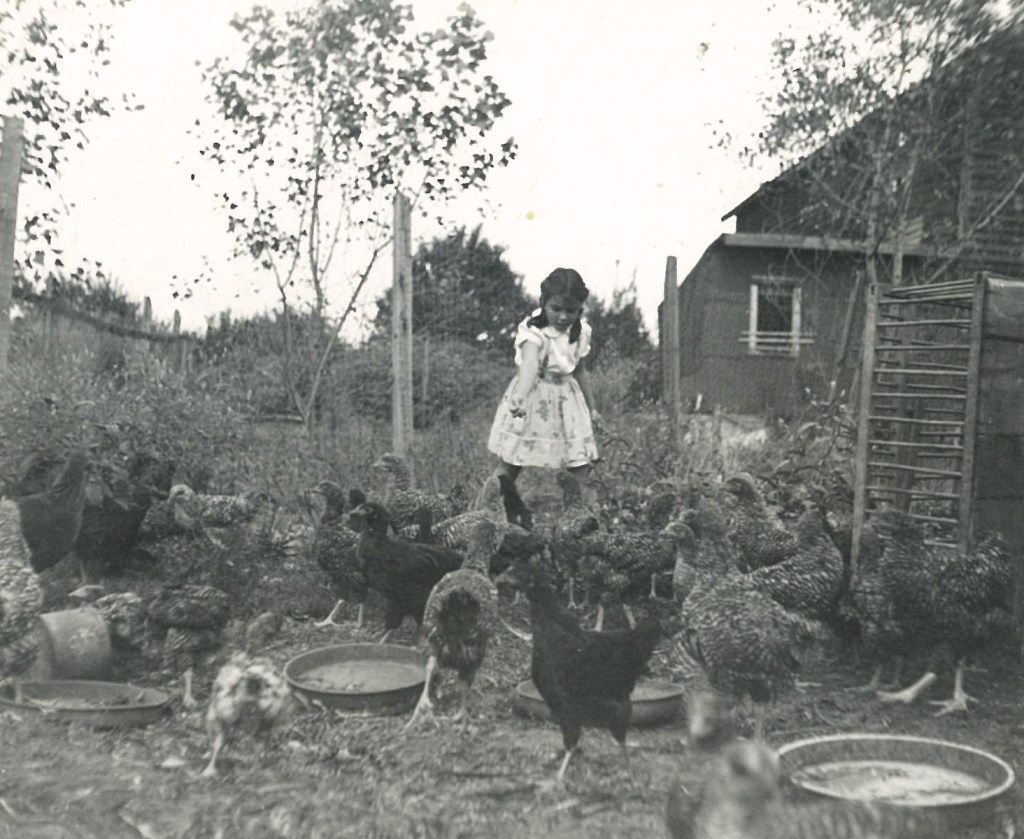
A LITTLE EXTRA: I’ve mentioned many times that my maternal grandmother had a working farm and pensione in North Branch, New Jersey, just outside of Somerville.
It was on about 100 acres that was mostly used for farming and all surrounding a sprawling wood-framed white house that was the Pensione, called Giovanna Farm. There were chickens, ducks, roosters, rabbits, pigs a goat named Billy, cats, kittens and my favorite mutt ever, my summer playmate and my partner in crime. We spent hours together while I played with the bunnies, washed the little piggies, dressed them in doll clothes and drove them around in a wheelbarrow. Happy was the keeper of all my secrets. The neighboring farm had cows and horses and I spent some time there too.
But back to the feedsack dress.
Of course, grains and flours came in sacks and these sacks, when empty, were valuable in that they were washed, bleached and fashioned into sheets, pillowcases, towels and, yes, clothes. We were coming out of a war and material was scarce and expensive. I had 2 much older sisters and many of their clothes were shared with my cousin and then reimagined into something for me, eventually. But one year when even hand-me-downs were scarce by aunt made me a flour sack skirt. Aside from the fact that it was itchy, it didn’t bother me to wear it. I had a friend on the neighboring farm up the road and she and her sisters all had flour sack clothes. So, it felt quite normal. When we went back home to our place in the heart of New York City, I attended Catholic school and had a blue uniform, 2 white blouses and white socks to wear until summer came again. However, as I remember, by the next year all the sacks were used for sheets and towels. I loved those days on the farm.

 Ancora
Leave a comment