(And Remembering My Little Nonna)
December 13th is a special day in Italy
and it was in my home also when I was growing up.
Twelve days before Christmas is St.Lucy’s Day. Symbol of light and hope, parts of Italy celebrate her legacy with feasts and gifts in many differ styles. Bergamo in particular makes a big deal out of December 13th. In the run up to the festival, children visit Santa Lucia Church and leave letters in a basket beside her statue. Much like letters to Santa Claus, these are filled with wishes for gifts and are usually accompanied by a prayer for a loved one or a pledge to behave well and think of others in return. On St.Lucy’s Feast Day itself, children awake to find gifts brought during the night by her, along with candies or sweets carried by her donkey.
My “Little Nonna” would sometimes give us (my younger brother and me) a cloth napkin (this was during war years when times were lean) which contained an orange, some nuts and maybe a few dried figs. She also made us Cuccia. My two sisters were much older than we were and I’m sure they received something too but I don’t recall.
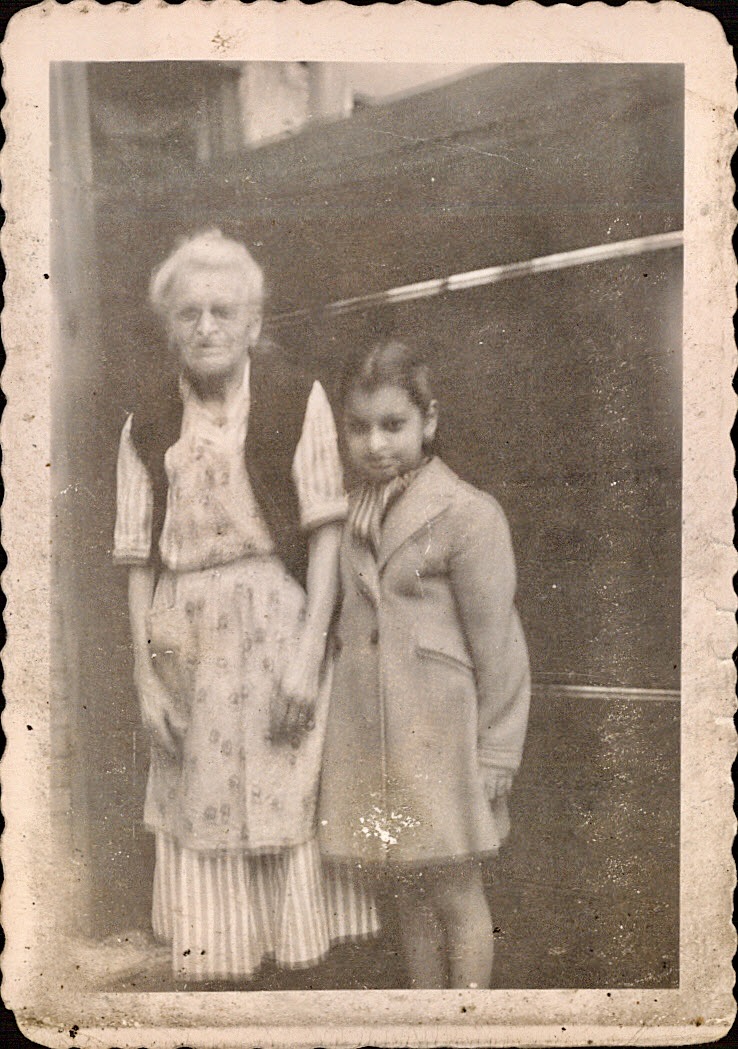
My little Nonna was really very little. Here we are together probably in 1947”. She raised 3 boys and then had to raise 2 grandchildren after their mother died shortly after childbirth. But, as we all lived mostly together in two adjoining brownstones, Little Nonna probably raised all of us….
5 cousins, 3 uncles,1 aunt, my parents, 2 sisters and me. She was there for me at lunch time when my mother couldn’t be. I always came home to a very inventive hot lunch. And I recall many family meals in her kitchen sitting around a big table while her mean-spirited cat Topsy would claw my legs. One scream and Nonna would chase her with the broom. Little Nonna didn’t speak a word of English and I never saw her lose her temper. Always the sweetest “Little Nonna”.
It’s not just children that enjoy the gifts of St.Lucy. For adults, it’s the chance to enjoy some great food. Being patron Saint of Light, St.Lucy is celebrated with torchlight processions and bonfires. During a severe famine in 1582 the people of Syracuse in Sicily prayed to Santa Lucia for help. Legend has it, soon after several ships miraculously appeared in the harbor, laden with wheat. So ravenous were the locals that they began eating the wheat as soon as it was unloaded, without even grinding it into flour. They simply boiled it and ate it as it was. In honor of this feast, a special dish was created, “Cuccia”. Made by mixing whole wheat berries with sugar or sweet ricotta, it’s traditionally the only wheat-based food that should be eaten on St.Lucy’s Feast Day.
Santa Lucia was born in Italy in the year AD 283 and suffered the death of a martyr in 304 AD.The Feast of Santa Lucia is celebrated on December 13th, the day of her death. Lucia, meaning light, Santa Lucia is the patron saint of the blind. It was her name I would be given at Confirmation. But, mainly because it was my Father’s Grandmother’s name. In her paintings or her statues, she is often depicted holding her eyes on a golden plate. I was always told that when she was martyred, her eyes were gouged out. But many different stories are told.
But who is this woman? She was born in the most southeastern tip of Europe and yet is venerated and celebrated all the way to regions in the northern? How did she travel across the land mass and become the bringer of light to so many? Was she sought out and her stories passed while gathered around winter fires in the woods? Or did she herself venture north, a pilgrim, a seeker, carrying her special medicine and wisdom with her, as a teacher? What kind of virtue did she really possess?
Lucy, who is venerated in the Roman Catholic, Eastern Orthodox, Anglican and Lutheran Churches, was born in the very southern Sicilian city of Siracusa. Siracusa was a Greek settlement and is known now for its ancient ruins. Lucy lived in Sicily between the late 3rd century and the early 4th century AD. We know about her now through the earliest document found that mentions Saint Lucy and which was unearthed in the Catacombs of St. John underneath the city of Siracusa.
Lucy was born into a wealthy Roman family in Syracuse (Eutychia, her mother, was most likely of Greek origins). Her father died and her mother had a horrible sickness. Lucy was raised devoutly Catholic, during the early years of Catholicism.
One story tells us that Lucy, in her earliest years had been betrothed to a pagan man that she refused to marry. After her mother died she gave away all her riches— and now that Lucy had given away what was to be her treasure of a dowry, this man was angered. He wanted to marry her and he wanted to take control of her wealth. So he denounced her to the local governor and turned her in as a “catholic” which at the time was prohibited as a religion in Sicily.
As the story goes the governor tried to break her Catholic will and wanted her to give into living a life of “pleasure and sin” so he attempted to send her to a temple of sacred prostitution. (I have to mention here that I never found any information about such a place. Neither have any of the family I have in Italy.) Nevertheless, Lucy refused to go. She had the will of God and she would not bend. And so the story goes, not even oxen could drag her to the temple. She stayed steadfast. Never prostitution for her. The governor also decided to set Lucy on fire. But the flames only danced around her, and never touched this Lucy’s flesh. She survived many attempts at being burned alive. In the end, they stabbed her in the throat with a dagger (she’s often depicted with a large dagger sticking out of her neck and that did kill her).
Local tradition mentions that Lucy removed her eyes when the one she was betrothed to told her he was in love with her beauty, especially her gorgeous eyes. So with the thought that he would leave her alone, she decided to give her eyes to him. And she did so by cutting them out and presenting them to him on a platter (this is the image we most often see of her with— a platter with two eyes). However, miraculously new eyes were restored to her. And so it makes sense that she became the patron saint of the blind and those with eye problems.
She’s most important to Sicily historically as the saint who fed Siracusa during the famine. In the late 1500’s, the people of Siracusa prayed for a miracle as they were starving to death. Suddenly, St. Lucy appears on a boat coming into the harbor in Siracusa. Two other boats follow her. Each boat is filled with grain, with wheat, enough to feed the entire town. All over the Mediterranean eyes are painted on boats, to both give the boat its own vision, to navigate and see as well as to protect the boat and these eyes are said to belong to Santa Lucia.
CUCCIA:
Ingredients:
1 ½ cup (pearled) farro
Enough water to cover farro in pot
1/2 teaspoon salt
1 1/2 cups whole-milk ricotta (made without gelatin or stabilizers)
Honey to taste
1/2 cup currants, raisins
Cinnamon and/or shaved dark chocolate and/or orange zest for garnish (optional).
1. Put farro in a pot and cover with enough water so it’s all submerged. Cook farro at medium high heat until it boils. Then reduce heat and all it to simmer for 20-25 minutes or until tender. Kernels will open up slightly. Non-pearled Farro will take much longer.
4. Turn off the heat and leave the farro in the pot to slowly cool. When farro is at room temperature, drain (if needed, as there may be no water left)
5. Combine the cooked farro with the ricotta. Stir until fully integrated.
6. Stir in your honey to taste, along with raisins. Turn into a deep serving bowl and dust with cinnamon and shaved chocolate and orange zest. Serve room temperature or warm in small bowls.
As you eat this simple meal, give thanks to your ancestors. To St. Lucy!
BUON MANGIATA!
DOLCI di SANTA LUCIA
St. Lucy’s Sweets
2 EGGS
¼ TSP SALT
1 TSP CINNAMON
2 CUPS CHESTNUT FLOUR*
2 CUPS PEANUT OIL
2 TBS POWDERED SUGAR
Beat eggs until thick and lemon colored. Mix salt, cinnamon and flour together and sift into the lightly beaten eggs.
Knead well until it becomes a smooth dough, adding more flour only if necessary. Dough must be very stiff.
Divide dough into 3 parts and roll each out to ¼-inch thick. Cut strips into strips that are 1-inch X 4-inch long.
Heat oil to 350º. Carefully add strips and fry until golden brown. They will curl as they fry.
Remove carefully from the hot oil with a slotted spoon. They will be fragile.
Do not add next batch until oil again is at 350º or thy will be very greasy.
After removing from oil, place on a plate and sprinkle with powdered sugar.
NOTE: You can purchase chestnut flour in specialty stores, Italian grocery store, but if not available white flour can be used on other day. You cannot eat these made with flour on the Feast of St. Lucy since it is customary to not eat anything made with flour on that particular day.
BUON MANMGIATA!

 Ancora
Leave a comment