AUGUST 15TH IN ITALY…..is quite an experience as our family joyfully witnessed several
years ago, when we were visiting our relatives in my most favorite hamlet in Italy, Montefollonico. However, the story that follows is quite fascinating in the history of this event. Unfortunately, this year August 15th is not on our calendar to be in Italy but for those that can join us here at home we will have a mini celebration.
- I may start the day with a breakfast “sweet” that was taught to me by my cousin Cristina when we were in Italy visiting family in Montefollonico, where my Father was born, and I aptly named it Torta da Montefollonico in my cookbook, Basta Pasta Ancora. And for dinner we might have Pici covered in Montefollonico Tomato Sauce. But we will toast one another with a sip of my cousin Andrea’s prized Vin Santo from a cherished bottle that we carried home on one of our trips. I love tradition!
PS: an interesting occurrence happens in Montefollonico on August 15th, as in all of Italy Mass is celebrated, however, in Montefollonico the special Mass is celebrated in their diminutive Church “Chiesa di Triano” which was built in 1609 to honor the Assumption of the Blessed Virgin Mary. Mass is only celebrated in this charming little Church on August 15th and is closed for the remainder of the year when Mass is then celebrated in Pieve di San Leonardo built in the 13th century and it is in this Church that my Grandparents were married and my Dad and one of my Uncles were baptized a long, long time ago.
But now on to a ferragosto story! (Yes ferragosto is not capitalized which I also thought interesting. But I was corrected several years ago and many times thereafter when I would mention this holiday.) This story is long, but I thought the history of this one day celebration
Some may find curious that the Palio di Siena, which also takes places in August, but on the 16th, and other famous horse races like the Palio dell’Argentario in Porto Santo Stefano, or the Giostra del Saracino in Sarteano, were all originally conceived to keep alive the Roman games of the Feriae Augusti, creating an ideal line between Ancient Rome and modern Italy through, of course, the important influence of the Middle Ages and the Renaissance, when these races – the Palio di Siena in particular – began being linked with the festivity of the Assumption.
Ferragosto, celebrated on August 15th, has deep historical roots that trace back to ancient Rome. The name itself derives from the Latin “Ferie Augusti,” meaning “the rest of Augustus,” commemorating Emperor Augustus who established this holiday in 18 BC. It was designed as a day of relaxation and festivity for all people, including slaves, reflecting Augustus’s desire to gain popularity and visibility among his subjects. The timing of this holiday, set in the middle of August, coincided with the Roman agricultural calendar and the Consualia, a festival dedicated to the god of fertility, marking the end of the harvest season and a period of rest for farmers.
(During the Ventennio, Italy’s time under the Fascists, propaganda invited Italians to enjoy a day out with the family on ferragosto, just like the Romans would have done 2000 years earlier: just another way to create a connection between Fascism and the Empire, something Mussolini was quite keen on doing. The idea was to create a state-supported holiday, much like the one Augustus had envisaged 2000 years earlier: workers’ associations – they were called associazioni dopolavoristiche – would organize hundreds of day trips for workers and their families all over the country and Mussolini, to support even further the initiative, introduced special trains, the treni popolari di ferragosto, with reduced fares. This enabled even lower income families to travel and enjoy a day by the sea, in the mountains or visiting one of our many art cities. The treni popolari di Ferragosto offer would run from the 13th to the 15th of the month and came in two versions: a one-day pass, for daily trips within a 50-100 km distance (31 to 62 miles), and a three-day pass, for trips between 100 and 200 km (62 to 93 miles). The institutionalization of ferragosto and the reduced-fare trains offered by the regime marked an important moment in the history of Italian habits and contemporary traditions because, for the first time, many families were able to travel recreationally. As the offer covered only train fares, people would bring along packed meals with them, marking the beginning of another popular tradition, that of the pranzo al sacco (packed lunch). Italians being Italians, pranzo al sacco could include anything from sandwiches to savory pies, salads, pizzas and focaccias. In the 1950s, another important tradition of ferragosto began, the barbecue: still today, grilling remains one of Italy’s favorite things to do on the 15th of August.)
As the Roman Empire transitioned and Christianity rose to prominence, ferragosto evolved into a Christian holiday celebrating the Assumption of the Blessed Mother. This transformation mirrored the adaptation of other pagan festivals into Christian ones, with celebrations in Italy often featuring fairs, processions, and local music.
In modern times, Ferragosto has retained its significance as a day for Italian families to come together, often involving travel and outdoor activities. During the Fascist regime in Italy, Ferragosto was utilized as a tool for propaganda, encouraging family outings reminiscent of those in ancient Rome. The government supported this with organized trips and special reduced-fare trains, making travel more accessible and fostering a tradition of enjoying meals outdoors, or “pranzo al sacco,” which includes a wide variety of foods.
Today, ferragosto is still a vibrant celebration characterized by barbecues, beach outings, and social gatherings, continuing to reflect Italy’s rich cultural heritage while adapting to contemporary practices.
The connection between the Palio di Siena and the ancient Roman celebrations of the Feriae Augusti is indeed a fascinating aspect of Italy’s cultural heritage. The Palio di Siena, held on August 16th, is a historic horse race that captures the spirit of competition and community, reminiscent of the games and festivities that took place during ancient Roman times.
Originally, these races were designed to honor the traditions and celebrations of the Feriae Augusti, which provided a festive atmosphere in the middle of summer. The idea was to preserve the spirit of the Roman games, linking the past to the present through these vibrant local traditions. The Palio di Siena, along with other horse races like the Palio dell’Argentario in Porto Santo Stefano and the Giostra del Saracino in Sarteano, serves as a living homage to this ancient heritage.
Thus, the Palio and similar events not only reflect Italy’s rich history but also showcase the continuous thread that connects modern Italians with their ancient ancestors, celebrating themes of community, festivity, and shared cultural identity.
However, let’s stay in the kitchen for a minute, because, as it happens as with important festivities, ferragosto has a special menu, too. In the past, it was customary to prepare roasted pigeon with rice, sausages and porcini mushrooms, especially in the North and in Tuscany; in Rome, you’d find chicken and peppers, while sweets aptly named Margheritine di Stresa were typical in Piemonte, as their name suggests (Stresa is a beautiful locality on the Lake Maggiore). These little, flower-shaped cookies deserve some attention because of their history and curious recipe: they were created in 1857 by pastry chef Pietro Antonio Bolongaro, in occasion of the first holy communion of Princess Margherita of Savoia, and what makes them special is the use of boiled egg yolks – along with sugar, butter and vanilla – for their preparation. Legends say the Savoias loved them so much they became a staple on their table for ferragosto celebrations.
Ferragosto is the climax of summer, a day to spend with friends and family, often having a barbeque together. It falls during the weeks when most factories close for the holidays and a majority of Italians drive to seaside locations for their canonical sea-and-sand vacation. For this reason, traveling around this period can be an adventure: it is usually advised to avoid the freeway on the days immediately before and after the 15th and today many avoid traveling around ferragosto altogether, in spite of tradition, preferring a dinner with friends or the always popular backyard garden barbecue.
But, ferragosto also brings along a light sense of melancholy with it for those in Italy, because it’s deemed for them the last of summer holidays and fall is just around the corner. The morning of the 16th is a summer hangover, often fraught with a sense of exhaustion and, in many a way, an oddly longing for the fall’s well-established routines. And there’s nothing wrong with that, it just means preparations for Halloween and Thanksgiving can begin soon. And then along comes Christmas with its multi-faceted traditions.
E Ora lo sai
AND NOW YOU KNOW!
BUON FERRAGOSTO A TUTTI!
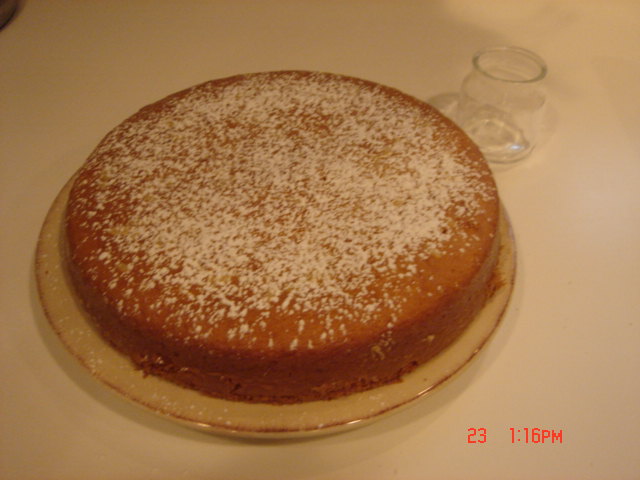
TORTA di MONTEFOLLONICO
Better known to us as Cristina’s Torta
On a visit to Montefollonico several years ago Cristina (my cousin Andrea’s wife) taught me how to make this torta which we had enjoyed there for years.
| 3 EGGS | 1 ½ CUPS FLOUR |
| ¾ CUP SUGAR | 1 ENVELOPE “LIEVITO PANE DEGLI ANGELI”* |
| 1/3 CUP OIL – mix ½ vegetable oil with ½ olive oil | PINCH OF SALT 1-2 TSPS VANILLA or ALMOND EXTRACT |
| 1 LEMON – zested and juiced | 4 OZ GREEK YOGURT – drained |
| POWDERED SUGAR – for dusting |
Preheat oven to 350º.
Beat eggs with sugar until yellow and creamy. Add oil slowly to egg mixture while beating. Blend in lemon zest and juice. Add yogurt and blend in well. Add flour, salt and Lievito. Bake in buttered and floured 10-inch round pan (I use a 10-inch glass deep-dish pie plate) for 20 – 25 minutes. Top should be a light golden color. Cool and dust with powdered sugar.
Note: Lievito Pane degli Angeli is a vanilla flavored rising agent for pastries and can be found in Italian specialty stores. I learned how to make this dessert when visiting my cousins in Montefollonico. Sometimes pignoli are sprinkled on top just before baking. It can be eaten for breakfast or served for dessert with Vin Santo. It can even be sliced in half, when completely cooled, and filled with a pastry cream.
As a good substitute for Lievito Pane degli Angeli you can use 2 teaspoons of baking powder, though it won’t have the vanilla flavor.
*Available at E. 48th Street Market
BUON MANGIATA!

 Ancora
Leave a comment